Supplier Chief of Staff. Agents that keep a pharma plant from running out.
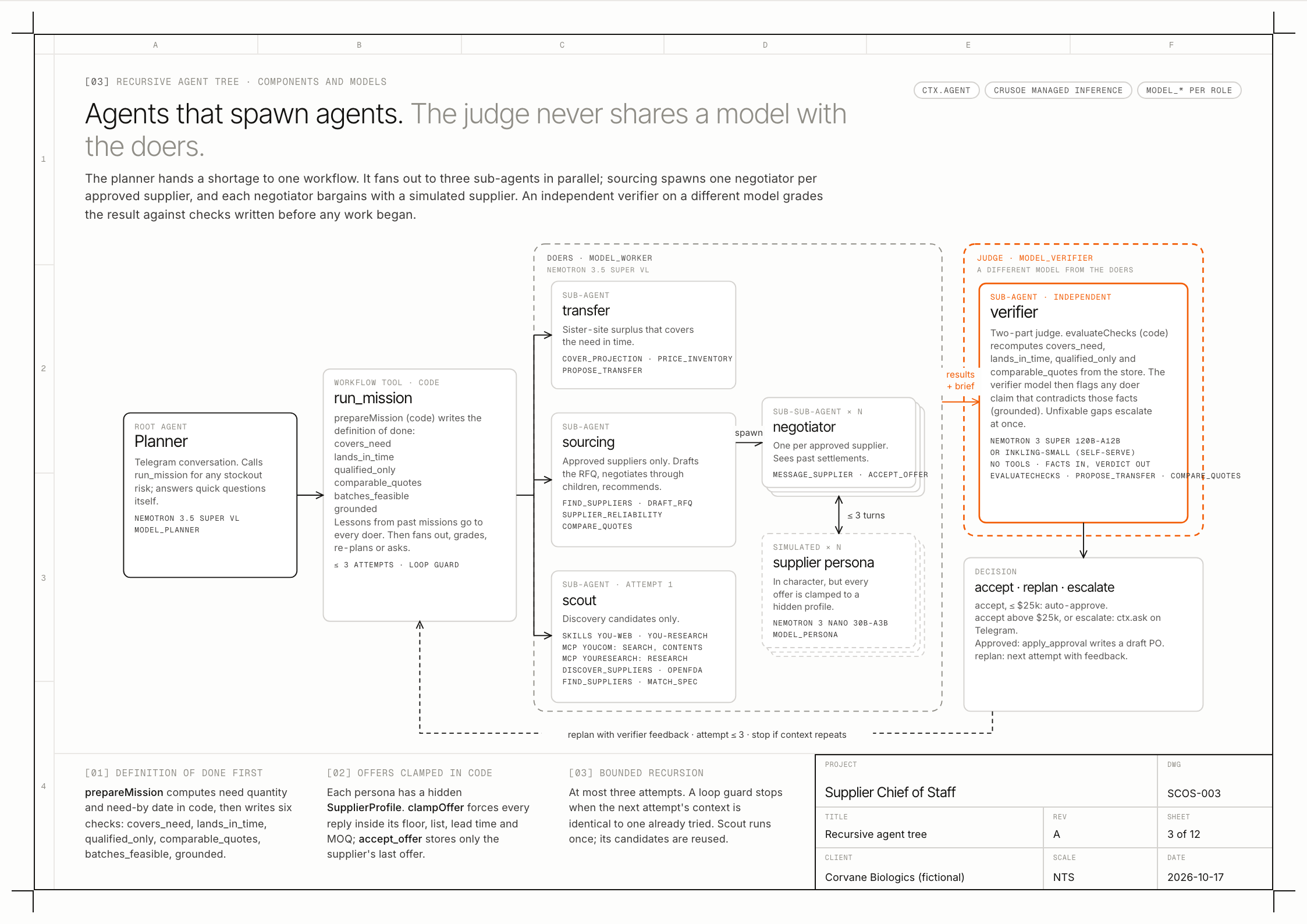
A sentinel watches every material at every site. When stock runs low, the agent writes its own definition of done, spawns sub-agents to find a transfer, negotiate with approved suppliers and scout the web, has an independent judge check the result, and texts the planner only when a decision is above its authority. It learns supplier reliability from every delivery.
Corvane Biologics is a fictional company; its inventory, suppliers and prices are synthetic. The models, orchestration, checks and approvals are real.
vs a manual planner, 90-day simulation, mean of 10 seeds
21,450 → 228 over 90 days; mostly one-tap approvals
stockout days vs the rule-based agent when suppliers overstate reliability
checks passed, about 3.5 minutes end to end on Vercel
How a mission runs
Sentinel
Scans every position daily with no model call. A breach opens a mission.
Six checks first
Covers the need, lands in time, qualified suppliers only, comparable quotes, batches stay feasible, every claim grounded.
Sub-agents fan out
Transfer, sourcing and scout in parallel. Sourcing spawns one negotiator per approved supplier.
Verify, re-plan or ask
Code recomputes every number; a different model checks the claims. Up to 3 attempts, then a human above $25k.
Go deeper
Mission theater
A simulated phone wired to this agent, next to the pipeline driven by its real event stream.
LiveEvidence board
Structure images, line-feasibility tables, QA packets and supplier evidence from missions.
CodeGitHub
Agent app, shared core, simulator, evals. Everything built during the hackathon.
ResultsSelf-improvement
Supplier reliability learned from deliveries, ranked by risk-adjusted cost per client.
ResultsSimulation
Manual planner vs agent on the same demand and supplier delays.
ResultsModel evals
Tool selection, guardrails, spec matching and negotiation across four Nemotron models.
Talk to it over HTTP
curl -s -X POST https://supplier-chief-of-staff.vercel.app/eve/v1/session \
  -H 'content-type: application/json' \
  -d '{"message":"What is running low at Ghent?"}'

curl -N https://supplier-chief-of-staff.vercel.app/eve/v1/session/<sessionId>/stream